Why the Journey Still Matters When the Goal Slips Out of Reach
They say the most dangerous part of any major project isn’t the chaotic launch or the final deadline push; it’s the middle, right when you start to feel comfortable. I was 2,000 miles into the Great Divide Mountain Bike Route (GDMBR), a 2700-mile odyssey from Canada to Mexico, and I had lulled myself into a sense of rhythm. I had navigated the wild weather of Canada, the isolation of Montana and Wyoming, and the high altitudes of Colorado. I was tracking my progress on spreadsheets, hitting my mileage targets, and mentally preparing for the finish line in Antelope Wells. Then, on a completely unremarkable strip of dirt road just outside Del Norte, gravity decided to teach me a lesson about control. In a split second, my journey shifted from a physical endurance test to a masterclass in humility, community, and the art of letting go.
The Illusion of Control
The day started with the kind of optimism that usually precedes a fall. I was leaving Salida, a town that felt welcoming with its “S” emblazoned on the hillside, mirroring the “R” I’d seen back in Rawlins. The weather was perfect; sunny, light winds, no rain in the forecast. I felt strong. I had even allowed myself a small detour to see the Elephant Rocks near La Garita. In business, as in cycling, we often view detours as inefficiencies, but that short diversion to see those massive, ancient rock formations reminded me why we take on challenges in the first place. It wasn’t just about the mileage; it was about the experience.
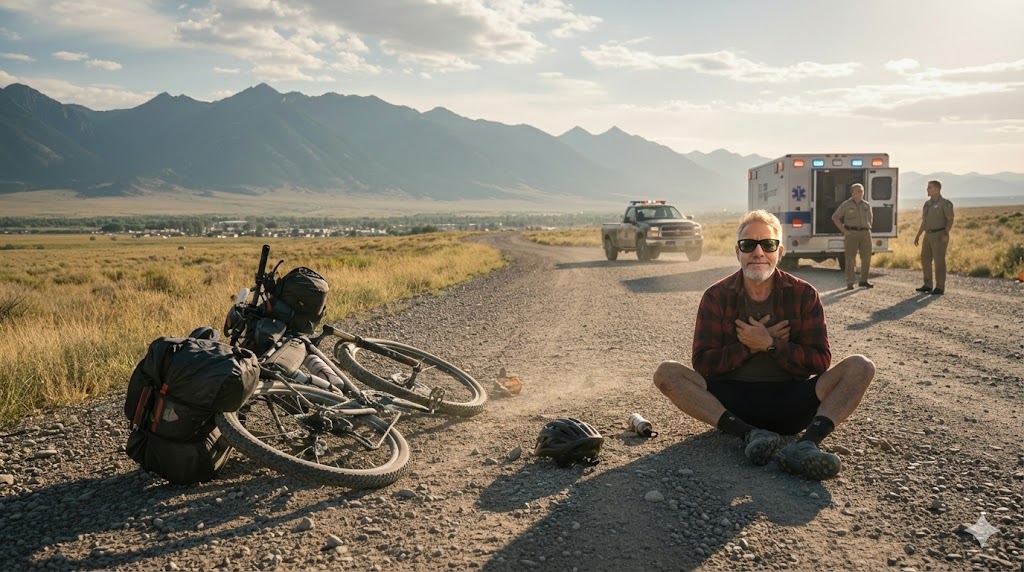
However, confidence can sometimes mask the fragility of our plans. I was descending from the high single track, transitioning onto a gravel road. It wasn’t technical terrain. There were no gullies, no boulders, nothing that screamed “danger.” Yet, that is often where the risks lie, in the mundane moments where focus drifts. I hit a patch of loose ground, and before I could correct, I was down. The silence that followed was heavy. My bike was in the dirt, and my body was screaming a warning that I initially tried to ignore. I did what many of us do when a project goes sideways: I went into denial. I tried to bargain with reality. I thought, “I can still ride. I can manage this.”
It is often in the moments where we feel most in control that we are reminded that the map is not the territory. True agility isn’t about predicting the future; it’s about how we react when the ground literally shifts beneath us.
The Strength in Vulnerability
Denial is a powerful anesthetic, but it wears off quickly. After struggling to get the bike upright and attempting to pedal into a fierce headwind, the reality set in. I was miles from town, in significant pain, and unable to function. This was the moment the “solo” adventure ended, and the human element took over. I had to make the call, literally 911, and admit that I couldn’t solve this problem on my own. For someone who prides themselves on self-sufficiency, waiting on the side of a dirt track for help feels like a profound failure. But it wasn’t.
The response was immediate and humbling. A sheriff arrived within ten minutes, followed by an ambulance crew who treated me with a level of care and reassurance that calmed my spinning mind. I was transported to the Rio Grande Medical Center in Del Norte, where the verdict was delivered: five fractured ribs. My ride was over. But this is where the story shifts from a tale of broken bones to one of human connection. The hospital staff didn’t just treat my injuries; they treated me like family. They offered me one of their “tiny houses” on the hospital grounds; accommodation usually reserved for patients needing long-term treatment. They let me stay for a week to recover enough to travel.
I met people like Jennelle and Eric, strangers who became friends in the span of a few days. Eric even offered to drive me four and a half hours to Denver for my flight home. In our professional lives, we often talk about “networking” as a transactional activity. But this was community in its purest form. I was grounded in a small town I never planned to visit, yet I felt more supported there than I had in weeks of solitude. It was a stark reminder that while we may set the vision, it is the people around us-often those we least expect-who help us survive the crises.
We often equate leadership with invulnerability, believing we must carry the burden alone. But my time in Del Norte taught me that asking for help isn’t a sign of weakness; it is the ultimate act of trust that allows community to rush in and support us.
Redefining the Finish Line
Lying in that tiny house, looking out at the mountains where the GDMBR riders were still passing by, I had to wrestle with the concept of failure. I didn’t make it to Antelope Wells. I didn’t cross the imaginary line I had fixated on for months. By the strict definition of my original KPI, I had failed. But as I reflected on the last 2,000 miles, the narrative began to change. I thought about the wet and wild forests of Canada, the endless expanses of the Great Basin, the sheer isolation of Idaho where I met only two people in days, and the majestic Tetons rising out of the mist.
I realized that if I judged the success of the venture solely on the final destination, I would be discounting the immense growth that happened in the previous 90% of the journey. I had climbed over 81,000 feet – nearly three Everests. I had learned to navigate bear country, fix mechanical failures in the wild, and push my body beyond what I thought possible. I had learned that I am capable of more than I imagined. The “exit” in Salida (and eventually Del Norte) wasn’t just an end; it was a pivot point. It gave me the space to stop moving and start appreciating.
In business, we are often so obsessed with the “exit strategy” or the quarterly target that we miss the value being created in the trenches. We forget that the data gathered during the “failed” experiment is often more valuable than the safe win. My data points were the kindness of the staff at Rio Grande Medical Center, the camaraderie of the cycling community, and the resilience built through weeks of grinding uphill. I promised myself an adventure, not just a destination. And by that metric, the project was a resounding success.
If we judge our journeys solely by whether we reached the original destination, we miss the point of exploration. Success is not a coordinate on a map; it is the sum of the resilience we build and the connections we make along the way.
As I pack my bike into a box and prepare for the flight back to the UK, I feel a strange sense of peace. Devastated? A little. But mostly, I am grateful. I am leaving with broken ribs, yes, but also with a restored faith in the kindness of strangers and a deeper understanding of my own limits, and how to expand them. Sometimes, you have to stop before you’re ready to truly understand how far you’ve come. Thank you for being part of this journey with me.
The route will always be there, but the lessons I’ve learned here in Del Norte are coming home with me now.