The Grinding of the Gears: A Week of Rain, Bears, and Brutal Beauty
I am Robin Hamilton: a slightly grumpy Englishman who, by his own admission, possesses no real athletic ability. Yet, there I was at Heathrow, pushing a 30.6-kilogram cardboard box that felt less like a bicycle and more like a lead-lined anchor.
People ask “Why?” and for a long time, the answer was external; a spark lit by a Ryan Van Duzer video. But as I sat in the departure lounge, the “why” became a quiet, internal fire. Over the last year, I had lost 37 kg in preparation. I had literally shed a previous version of myself to make room for this journey. Now, I was heading toward a trail that didn’t care about my past, my weight loss, or my intentions. It only cared if I could keep the wheels turning across 2,700 miles of mountain wilderness.
The Baptism of Bow Valley
Banff is beautiful in the way a postcard is beautiful; sanitized and scenic. But the moment I rolled my overladen bike out of the hotel, the Rockies stripped away the sentimentality. It wasn’t just raining; it was chucking it down with a relentless, icy indifference.
By the end of Day One, the concept of “dry” was a ghost of a memory. I wasn’t just wet; I was saturated. My Gore-Tex jacket, my socks, the very fibers of my soul felt heavy with mountain water. I covered a hard 49 miles and 3,400 feet of climbing that first day, but the numbers are hollow. The real story was the bone-deep thrumming of a cold that starts in your fingers and ends in your spirit. There is a specific kind of exhaustion that comes from being wet and cold for twelve hours straight. It makes your hands shake as you try to light a camping stove in a dark, muddy campsite. I crawled into my sleeping bag feeling small and listend for the rustle of wildlife int he forest. The mountains, the trees, the mud; they weren’t cheering for me; they were just there, ominous and silent, waiting to see if I’d quit before the sun came up.
The Hypnosis of the Gravel
By Day Two, a new sensation took over: the sound. When you are alone for hours, Sometimes the scenery takes your breath away, other times your world narrows down to a three-foot patch of dirt just in front of your front tire. And then, you hear it, the hypnotic, rhythmic crunch-crunch-crunch of rubber on gravel. On the smooth sections, it’s like white noise, a lullaby that pulls you into a trance. But on the “Baby Head” roads following Elk Pass, that sound turns into a violent grinding, complete with the bike shaling so much you start to lose feeling in your fingers.
Imagine miles of smooth round stones, each the size of a toddler’s head, all conspiring to slip beneath your tires. I was forced off the bike, pushing the bike (now named ‘The Tank’) up vertical inclines until my calves screamed and my lungs felt like they were filled with crushed glass. In the silence of the Elk Valley, the crunch of my footsteps and splahing through puddles was the only evidence I still existed. The loneliness there is a physical weight; if I fell, if I broke, the only witness would be the jagged, snow-dusted peaks. It is a terrifying exhilaration; to be so far beyond the reach of a safety net that your only choice is to keep moving or disappear.
The Psychological War: Bears and Broken Maps
The fear on the Divide isn’t a constant scream; it’s a low-frequency vibration. It hits you when you enter tight singletrack through trees; even more so when you see a sign that simply says “BEARS” followed by a list of “Do’s and Don’ts” that sound like instructions on how to be a more polite snack. Every rustle in the thick pine brush became a grizzly. Every shadow that shifted at the edge of my peripheral vision was a mountain lion. You realise very quickly that you are not at the top of the food chain.
You are a guest in a very dangerous house, sleeping in a thin nylon tent that offers the protection of a paper bag.
This psychological toll was compounded by the failure of technology. My Garmin mocked me with spinning loading circles; the digital maps I had meticulously curated refused to load. I found myself standing at a junction in the pouring rain, staring at a paper map that was slowly turning to grey pulp in front of me, in my hands. The rising panic of being truly lost in the wilderness is a cold spike in the chest. All very different from financial, resourcing and shareholder meetings!
The Altar of the Fritter: Trail Magic and Heaven
But the Divide gives as much as it takes. When the darkness is at its heaviest, “Trail Magic” appears. I reached a section of the High Rockies Trail that was closed, my navigation dead, my spirit flagging. I stared at the ground; despondent. There, laid out in the dirt by northbound riders who had passed through days before, was an arrow made of stones. That simple pile of rocks was more than a direction; it was a handshake across the wilderness. It was my new-found tribe whispering, “We were here, we made it, and so will you.”
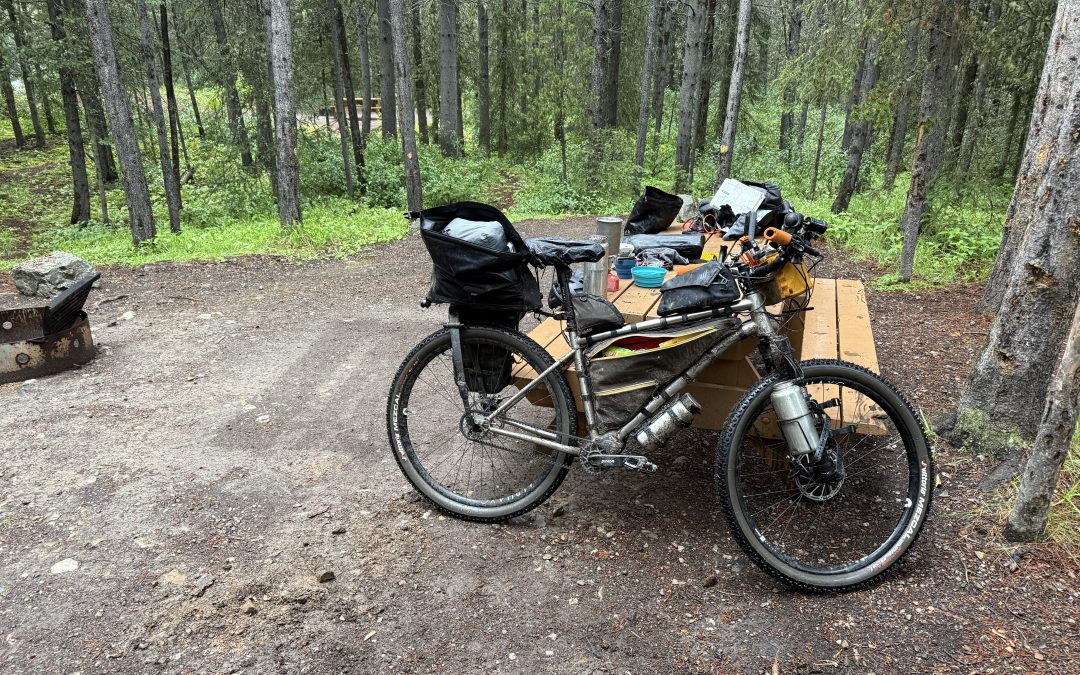
And then, there is the food. On the trail, your senses are heightened until the simplest thing becomes divine. I remember making coffee at a picnic table at Lake Kananaskis, the steam rising into the damp air. It wasn’t just caffeine; it was a semi-religious experience. I found a coconut latte Eureka, drinking it while the sun finally baked the dampness out of my bones, caked in three different types of mud, and wept internally at the sheer perfection of it all, wth the mountains looking on; waiting. Later, at the Polebridge Mercantile, I was handed a free fritter; a massive, sticky, berry-filled delight. I didn’t eat it; I communed with it. In a world of 3,000-calorie daily deficits, a piece of fried dough is the closest thing to heaven a bikepacker can find.
The Big Sky Sanctuary
Crossing from Canada into Montana was bittersweet. Canada had been a brutal teacher, but its majesty was unparalleled. As I crossed the border, the horizon opened up. The “Big Sky” isn’t a marketing slogan; it’s a reality where the world seems to inhale, revealing vast, golden valleys that roll on forever.
My first week ended at the North Fork Hostel in Polebridge. This place is a miracle of cedar and solar power, run by a charming man named Oliver who came for a night in 1991 and simply never left. Walking through the hostel, past walls covered in decades of travelers’ notes, I realised that the tension I’d been holding for months, perhaps years, had left my shoulders. I had done 55 miles and 2,400 feet of climbing that final day. My legs were heavy, my bike was battered, and I still had 2,500 miles of dirt between me and the Mexican border.
But as I sat on that porch in the Montana sun, taking in the smells, the sounds, and watching the light fade over the mountains I had just conquered, I realized the grumpy Englishman was gone. In his place was a man who knew how to find his way by the stones on the ground, a man who found joy in a plastic cup of coffee, and a man who was no longer afraid of the silence, or having himself for company.
The first week was over and I’d survived. I was sore, I was tired, and I was exactly where I was meant to be.